If you're staring at water on your floor right now, you probably want one thing first: a number. Here's the honest answer, followed by the reasoning behind it.
What's the typical price range?
Water damage restoration costs vary more than almost any other home service, because the price is driven by water volume, contamination level, and how much time passed before extraction started not by a flat rate per square foot.
- Minor cleanup (small leak, caught early, no porous material soaked through): often a few hundred dollars.
- Moderate water intrusion (a flooded section of basement or a room with soaked carpet and drywall): typically runs into the low thousands once extraction, drying equipment, and monitoring are factored in.
- Major flooding or prolonged exposure (water sitting for days, multiple rooms, contaminated water from a sewer backup): can run several thousand dollars or more, especially if drywall, subfloor, or framing needs to be removed and replaced.
The single biggest cost factor isn't square footage it's time. Water that's extracted within hours costs far less to remediate than water that's been sitting for a day or two, because dry materials can often be saved while soaked materials usually can't.
What actually drives the price up?
How long the water sat before anyone responded
This is the factor most homeowners don't think about until it's too late. Drywall, subfloor, and framing all begin absorbing water within the first few hours. The longer that goes on, the more material has to be removed instead of simply dried.
The type of water involved
Clean water from a supply line break is the least expensive to handle. Water from a sump pump backup, sewage line, or floodwater carries contamination risk, which requires more thorough cleaning, disposal of porous materials, and antimicrobial treatment all of which add cost.
What materials were affected
Hardwood floors, carpet with pad, and drywall all respond differently to water exposure. Some can be dried and saved; others need to be removed and replaced. A technician's inspection determines this on a case-by-case basis, not a generic formula.
Does insurance typically cover this?
Often, yes particularly for sudden and accidental water damage like a burst pipe or appliance failure. Gradual leaks and certain flood scenarios are usually excluded under a standard homeowner's policy. We cover this in more detail in our insurance coverage guide, but the short version is: document everything, and call your insurer and a restoration company close to the same time.
How do I get an actual number for my situation?
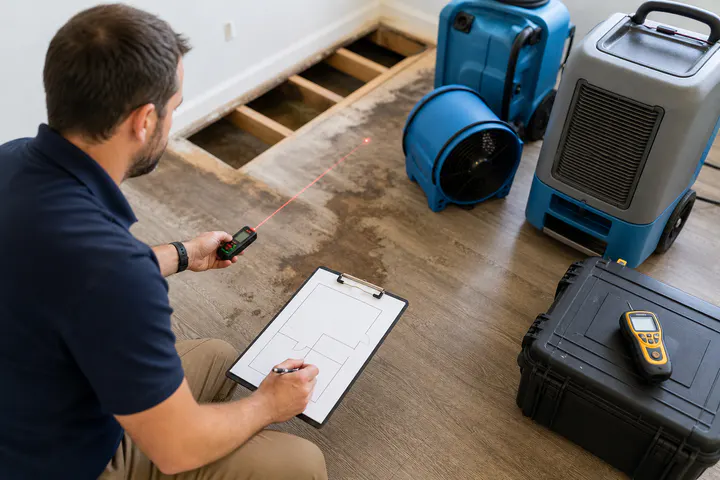
The only accurate way to price a water damage job is an in-person inspection. Anyone quoting a firm number over the phone without seeing the damage is guessing. A real inspection checks moisture levels behind walls and under flooring damage that isn't visible from a quick look around the room.
Related Idaho Falls service
Costs depend on how fast extraction and drying begin. See our water damage restoration in Idaho Falls page to request help and get the damage reviewed.
Want a real number for your situation?
On-site inspections available. A local provider can review the damage and give you a clear scope before work starts.
Call (208) 502-6969